Showing posts with label Argentina. Show all posts

Monday, July 18, 2011

River Plate's Loss as a Metaphor for the History of Argentina

On June 26th, the unthinkable happened: the Argentine football club River Plate got demoted to the B league. It's an event that provoked this kind of reaction throughout the country and the football-playing world:


For those of you who don't follow Argentine football, let me explain. The two strongest teams in Argentina have always been River Plate and Boca Juniors, and they have a rivalry that's practically unmatched anywhere else in the world. Every person in Argentina is a fan of either one or the other. When the two teams play, it's the sporting event of the year.

River (as it's known colloquially) has been one of the most successful Argentine clubs of all times. But lately they've been struggling, and losing, and losing. By June 26th it got to the point where River had to win the match in order to stay in the top ('A') league of Argentine football. It should have been a no contest; they were playing some no-name team from the interior.....and still they lost.

A dedicated River fan became so irate while watching that fateful game that this video of his tirade has made him the most well-known man in Argentina:


[As you'll soon tell, there aren't many different kinds of curses in Argentine Spanish. This man uses about three or four principal insults, with variations and combinations:

"la puta que te pario" = the whore that gave you birth
"pendejo / boludo / pelotudo" = stupid / asshole
"andate a la concha de tu madre / hermana / etc." = your mother / sister's /etc.'s pussy

At one point he cries out, in supplication, "¡No les pido que hagan 28 pases como el Barcelona, hagan dos seguidos, nada más!" ("I'm not asking you to make 28 passes like Barcelona, just two in a row, nothing more!")]

On the media circuit on which this poor man was later dragged, he sheepishly explained that he did go a little too far. But really, given the situation, who can blame him? Imagine being a fan, a devotee of River, learning from a young age to adore the River jersey, to be proud of a team with an international reputation and a long, glorious history; and to have that team that you so adore now be known as just "some other" team, with bygone glory days?! It's hard to comprehend how one copes with such a trauma.

But these kinds of falls from glory aren't new to Argentina. Rolando Hanglin, writing for the daily La Nacion, puts this story in its larger context, tapping into the essence of the Argentine psyche:
River ya no es la élite del fútbol mundial. Es sólo un equipo que fue próspero y señorial (de ahí el apodo de "Millonarios") con una escuela refinada, que se ha perdido. Además, está rodeado del entorno que corresponde a un país del Tercer Mundo. Un país que fue rico hace ciento veinte años, y que ya no lo es.

"River is no longer in the elite of world football. It's just another team that used to be successful and noble (from there came the nickname of "The Millionaires") with a refined school that has lost its way. In addition, it's surrouned by an environment that corresponds to a country in the Third World. A country that used to be rich one hundred twenty years ago, but no longer is."
What Mr. Hanglin is referring to is how Argentina (believe it or not) was contending with the United States as a world power in the New World around the end of the 19th century. Why not? Argentina had a vast resource endowment, skilled European immigrants, industry and trade. All signals pointed to success. But now all the books written on the history of Argentina have the subtitle, "What went wrong?" (how Argentine ended up "failing" is a subject that has so interested researchers that it has its own name: the so-called "Argentine Riddle").

For decades now, economists and sociologists from Latin America's dependencia school have been arguing that poorer countries have an inherent disadvantage when competing in the world economy. Something analogous seems to be true for football in the case of River: as D.S. over at The Economist notes,
The cruelest consequence of relegation, of course, is that the demotion itself makes it much harder for a club to work its way back up to the top:" River’s annual television revenues will fall from $6.8m to about $4m, and it will have to cut ticket prices. It will probably lose transfer income as well, since few European clubs search for talent in the second division.
For Argentines with pride in their people and their country, all this must be terribly frustrating. How do you prove you don't suck? If you're a batter in a slump, every hit you make seems fleeting; every strikeout just confirms and reemphasizes your worst fears. Similarly, every time the newspapers in Argentina report rising inflation, or the lack of respect their dignataries receive abroad, the more and more Argentines confirm their fears that they're stuck in the "Third World" (a category that they care a lot about, critical theory be damned) forever.

Argentines respond to this frustration in different ways. There are some (especially the rich) who stopped caring, and have simply shifted allegiances to America or Europe. They openly put down their country and go on and on about how glorious it is abroad. Then there are those who care about their country, but resigned at its fate. Many still harbor resentment against the world superpowers, especially Britain and America, for having cheated them out of a better position in the world pecking order. Throughout Latin America, Argentines are derided for their arrogance, and they have it, it's true; but when we see that arrogance through the lens of their history, it's much easier to sympathize and understand how they're feeling.

Like Argentina, which has been struggling to find its identity for the past century, River too will have to reorient itself in the world of football. Most Argentines haven't handled their country's fall from grace well, and remain bitter at the world. Let's hope River fares better.

Thursday, November 11, 2010

Blast from the Past

Did you know that the New York Times maintains online searchable archives all the way back to 1851?

Here, for example, is an article I found while researching U.S.-South American trade relations:


It's funny to see how news from so long ago reads as if it were contemporary. At the bottom of the page, in small print, the publication date reads: May 24, 1914.


From the artist's rendering, it seems like the Plaza de Mayo has seen better days. For some reason the full-bodied trees shown here have been replaced with gangly palm trees:

Tuesday, August 31, 2010

Sir, I have a bone to pick with you

From the Economist's online edition comes this article about the Argentine government's offensive against Clarín, the nation's media conglomerate. After describing the Kirchner's efforts to "kick Clarín out of the ISP business" and "wrest control" of its share in Argentina's newsprint company, Papel Prensa, the author, D.P., makes the following conclusion:
By declaring war on Argentina’s most powerful opinion-former, the Kirchners are gambling with their political future. If they can bloody the company enough to make its management seek a truce, they could secure friendlier coverage of the 2011 presidential election. Even then, however, the strategy might backfire. First, it has made them look hypocritical: by trying to kill Fibertel, they have made the already-concentrated ISP market even more so. Moreover, they have given the fractious opposition a new cause to unite around.
For the first time, I actively disagree with the Economists' appraisal of the facts. Kirchner, I feel, is actually winning political points in this campaign against Clarín. No one I met there truly supported them. The left excoriated Clarín as a propaganda machine for the wealthy.1 Moderates admitted that it attacked the government more than necessary, and preferred to read La Nación. Above all, almost everyone felt uneasy by Clarín's near-monopoly status over print, radio, and television media.

The backdrop of President Kirchner's actions, which the Economist article strangely omits, is the push to pass La Ley de los Medios (The Media Law), whose explicit intent and purpose is to trust-bust Clarín's monopoly. Although the law is controversial (like everything in Argentina), it enjoys broad popular support. Here, for example, is a snapshot of the turnout for the rally in favor of La Ley de los Medios outside Congress in Buenos Aires in late April:


Most people I talked thought the law was a good idea. The professor who taught my peronismo class, someone who struck me as an intelligent and consummately careful scholar, opposed it, but only because she thought it was badly crafted. The law would simply replace Clarín's monopoly with a government monopoly, she said, but she didn't disagree that something had to be done about Clarín.

So I don't know why D.P. feels that the Kirchners are "gambling with their political futures." Perhaps the issues of Papel Prensa and Fibertel, both of which developed after I left Argentina, have created new opposition or turned the tide of opinion. But I doubt it.

Update (Sept. 1, 11am):
Another point, which I forgot to mention—The article, entitled "Pressed," portrays Clarín as a poor victim of government abuses. I think the abuse really goes both ways. In any case, I don't think anyone feels sorry for Clarín.

Notes:
1. I've heard people claim that Clarín has fabricated facts, grossly misrepresented inflation, and engaged in all kinds of journalistic malfeasance; but in Argentine politics there are so many claims and counterclaims flying everywhere that it's difficult to assess their veracity.


Bonus Feature!

The article offers this link (available only in Spanish) to a government report on business dealings with the Papel Presna company. The report is full of account balances, citations of laws and decrees, and other boring details, but in true Argentine fashion that doesn't stop the authors from proclaiming this issue as a matter of the most profound human rights. The excerpt from the Acknowledgments section reads (with my translation):
We thank especially those people who, having been participants in these acts, through their testimony permitted us to reconstruct an era of history in which were carried out the most dark and horrible acts of of physical, moral, and psychological violence that human beings can suffer.

It should be highlighted the interest demonstrated in the search for the Truth, shown by all the institutions, organizations, and people who, in one way or another, and from their respective places, helped with their contributions so that this present report would illuminate a part of history that tried to be submerged in darkness until it fell in negation, lies, and oblivion.
They're obviously referring to El Proceso, the brutal internal genocide that took place during the military dictatorship of the 70s. Many of the incidents of this report probably also take place during the 70s, and I'm sure that the business dealings they describe are pretty messy, and probably involve violence—but there's no way it can compare to the torture, murder, and rape of the era they are so strongly evoking.

Monday, August 30, 2010

What Makes the Dollar Special?

One of the most jarring things about America after returning from Argentina was seeing so many dollars bills everywhere. I remembered sitting in my Monetary Economics class at my university in Buenos Aires, listening to the professor drive home the point that Americans use the USD as local currency. They don't see anything special about it!, he exclaimed, wide-eyed and emphatic, as if it were an utterly preposterous idea.

And he's right, of course; we Americans look out and see the plurality of currencies and assume ours is just another member of the ranks.

Argentines, however, have an entirely different point of view. Argentina has what they call a "dual currency," which means that dollars are just as standard a medium of exchange as the Argentine peso. For example, most restaurants have a sign on the door that indicates the rate at which they exchange dollars and euros. Apartments are bought and sold in terms of dollars, not pesos, which means Argentines maintain dual accounts of pesos and dollars. I saw wealthy Brazilians vacationing in Patagonia with a stack of crisp $100 USD bills in their wallets, and I even saw Argentines with large sums of USD, even while they were traveling within their own country.


So then, what makes the dollar so special? Why does it hold such a privileged status in other parts of the world?

Most of all, because it is highly stable. Inflation is usually very low, America has never defaulted on a loan, the US Federal Reserve is highly disciplined.

That may sound incredibly boring, but it is enough to get an Argentine who's lived long enough teary-eyed. Just over the past 30-40 years alone, the Argentine monetary authorities have dropped about 13 zeros off the currency; prices were rising so fast during the hyperinflation of the 80s that grocery stores couldn't relabel their items fast enough; and in the 2001 economic crash the dollar exchange rate jumped from 1:1 to 4:1 overnight.

In response to such a high degree of instability, Argentines have sought refuge in the dollar. Highly durable goods, like apartments, are priced in dollars to protect against wild, transient fluctuations. During hyperinflation, even school kids as young as 10 had come to learn that as soon as they obtain extra spending money the first thing they should do is invest in USD.

Even in stable times, like now, holding pesos is still inferior to holding dollars. The exchange rate may say 4 pesos = 1 USD, but in all practicality the two are not equivalent. Having four Argentine pesos is just not as good as having one small dollar. The reason is that although the peso may be stable today, there is no guarantee it will stay stable tomorrow. The fragility of the Argentine market means that holding pesos always carries with it an implicit risk of devaluation.

By the same token, holding dollars carries with it an implicit guarantee from the US government that the currency will preserve its value over time. Because Latin American governments have a history of irresponsibly financing extra spending by printing more money (i.e. inflation), their central banks maintain a reserve of dollars to keep their populations' anxieties at bay. The idea is that if anyone loses faith in the local currency, they can simply swap it out for dollars.

Note how the dollar acts as a monetary guaranteer of the last resort: when people lose faith in all currencies, they turn to the dollar. Thus, what makes the dollar special is that everyone in the entire world trusts in it. It also means that the United States is not only underwriting the monetary stability of its own citizens, but also that of the entire world financial system. Everyone assumes that in a panic at least they'll be able to salvage their savings by converting them to dollars.

The USD is therefore not just another currency, but rather a promise. A promise that in this fiat world of meaningless paper bills, your savings actually mean something.

Saturday, July 31, 2010

What I Learned From Argentina

1. We all have our roles to play.

Watching the behavior of others, I soon realized that some people have more of a right to a seat on the bus than others—and that as a young, healthy man I'll be the last one to sit down. Even if a seat opens up right in front of me, I learned I should always give it to the pregnant woman or old man standing next to me first. At first it annoyed me that I had to do this, especially when I was tired, or in a bad mood, or just didn't want to have to stand for the hour long bus ride. Over time, though, I came to realize that the tiredness I felt could just be a fraction of the tiredness that the people I gave my seat to must be feeling. I'm not old enough yet to understand what it's like not to be young and healthy, but I should at least be sensible and realize where I fit in in society. In life we find that we've been giving certain roles, sometimes by our choosing (husband, father, friend), and sometimes not (young, healthy, man). Life needs people in all types of roles, and once you recognize the role you're cast in, the right thing to do is play it properly.

2. People don't necessarily have to have similar mindsets to appreciate each other's company.

In Argentina you describe people that make good company by saying they have "buena onda," which literally means "good waves." Someone with buena onda doesn't necessarily share the same values as you, may use more swear words than you would normally approve of, or may have different interests. But that doesn't matter. All that matters is that their heart is in the right place, that they like to enjoy themselves and they like to see you enjoy yourself, and that they're sincere and genuine. Don't worry about the faults (just like they don't worry about yours), since after all we're all just trying to get along.

3. I'm a vegetarian.

Since I was raised in a vegetarian household, I always took my vegetarianism for granted. It was just the natural state of affairs at home. In Argentina, however, staying vegetarian meant I had to actively refuse to participate with everyone else; I had to mark myself in opposition.

All my life I've grown up surrounded by a meat-eating culture. I would see my friends eating meat, and me not, and not think anything of it, reasoning simply that we were just brought up in different ways. But now I'm no longer able to say I'm a vegetarianism simply because of my upbringing. I'm free to choose, one way or another. To stay vegetarian means I must sincerely believe that it is a better way of living, and that meat-eating is worse.

4. Simply recognizing someone's presence can mean a lot.

In the US we have the bad custom of tending to ignore people we don't know in a crowd. I was really glad to find that Argentina didn't have it. If I was talking with a group of kids from class, and another kid came to join the conversation, he would say hi to me with the same friendliness that he would show to everyone else in the group. When you're in a foreign land, insecure about your language skills, lonely, not having many friends, small gestures like that can mean a lot.

5. Things take time.

I went to Argentina assuming that if I gave enough effort, I could leave 5 months later speaking Spanish like a native. Obviously that didn't happen. I tried as hard as I possibly could, but even at the end of my trip I found that if I didn't speak Spanish for a couple days I would start to lose the hang of it. It took a couple weeks before I made any noticeable improvements in the language in the first place. I now realize I can't rush it. To truly speak like a native requires multiple years of immersion, and neither sweating more nor growing unnecessary gray hairs will speed up the process.

Friday, June 25, 2010

America, The Teenage Pop Star

Uno de los cuentos más populares de Gabriel García Márquez se llama "Los funerales de la Mamá Grande." Además de tratar, obviamente, los funerales, también incluye una gran crónica del reinado de la Mamá Grande, una figura matriarcal que maneja todo el poder del pueblo. Ella pasa los días en su mecedor de bujico, mientras que su sobrino Nicanor se ocupa con la resonpsabilidad que inevitablemente viene con tanto poder.

Una interpretación de la Mamá Grande es que en ella encontramos una imagen de Colombia: su reinado es una dictadura, su poder viene de herencia, su único trabajo es coleccionar arrendamientos, y, sobre todo, se está muriendo. Es el resumen del sistema de poder agobiante y opresivo de Colombia.

Una línea de pensamiento para entretenerte: Si bien Colombbia se puede caracterizar como una vieja Mamá Grande, cuál imágen escogerías para tu propio país (en mi caso, los EE.UU.)?

Es bastante divertido—y difícil—pretender clavar la esencia de la vida política y social de tu patria con un solo personaje. Pero creo que mi respuesta será: los EE.UU. son como un Teenage Pop Star.

Por un lado, los pop stars, como los EE.UU., tienen mucho glamour, mucha buena fama, mucha popularidad, muchos afanes. Siempre se habla de ellos, siempre llevan las modas más nuevas, tienen los cuerpos más codiciados, las vidas más interesantes. Se piensa que tienen lo mejor de todo (una vez un muchacho argentino me contó que le sorprendió la pobreza que vio en Denver, Colorado, como no esperaba que la encontrara en el "Primer Mundo"); son admirados por muchos (los commentarios que he oído de los argentinos incluyen, por ejemplo, ¡qué estable! ¡qué creativo! ¡qué disciplinado!); y tienen una presencia cultural omnipresente (todo el mundo conoce tanto a los pop stars norteamericanos como la cultura general norteamericana, desde los Simpsons y películas hasta el football y música).

Fíjate que este es el discurso del exterior. Adentro, nosotros ciudadanos no solemos ver el país como un gran milagro sino una larga serie de problemas para enfrentar: una economía temblante, gran recortes en los presupuestos estatales, el terrorismo, la inmigración, la jubilicación de los baby boomers, un sistema de salud terrorífico, y un racismo intransigente, entre otros. Esta "realidad interior" se parece al hecho de que la vida privada de los Teenage Pop Stars es bastante cotidiana. Tendemos a olvidarlo, pero los pop stars son personas también, con las mismas frustraciones, las mismas ambiciones, los mismos deseos, y las mismas preocupaciones que tenemos todos. Igualmente, los EE.UU., por más poderoso que sea, es a la vez sólo un país más.

¡Ya te toca a tí! ¿Cómo describirías a tu país? Deja un commentario con tus ideas.

Sunday, May 30, 2010

Perspective

Yesterday I met an Argentine woman who worked for a while in a hostel in El Calafate, a small town in the deep south of Patagonia. Even though El Calafate is so small that it doesn't have a movie theater, it attracts tourists by the busload because of the spectacular views of the glaciars:


As part of the conversation (in which I participated very enthusiastically, since I'm planning on visiting la Patagonia soon), I asked her which groups of people would pass through the hostel. Depends on the season, she said, and continued to describe the tourist seasons with seasoned experience. Brazilians, Uruguayans, and Chileans all the time; Israelis in the spring; Europeans in the summer, generally, etc., etc.

One of the biggest groups was the Spanish. Apparently they can take a full year of paid vacation, so many of them decide to take world tours in that time. (This is such an outlandish benefit that as I'm writing this I'm worried that I heard wrong.) The most annoying thing, she said, was how the Spanish kept on asking at the hostel if they had any discounts—not because they were poor (since, after all, they came with Euros, which were at least 5 to 1 here), but because they were taking such a long, grand trip that they wanted to make the money last. Little did they realize that the person from whom they were requesting a discount had a hard enough time making a good wage at the job they have, let alone taking a year off like that to travel the world.

This story reminded me of a saying: "I used to complain that I had no shoes, until I met a man who had no legs."

Friday, May 7, 2010

Below the Belt

Among other things, Buenos Aires is surely the lingerie capital of the world. Walking down Avenida Santa Fe, I'm sure to find at least one lencería per block, sometimes more. The majority have the same basic layout—two display windows exhibiting their selection, with a passageway in between that leads to a small intimate shop—and in every lencería I pass by I'll almost always see a couple customers on the other end of the passageway, or a woman stopped to peruse the offering at one of the two display windows. Clearly, there is a lot of demand for lingerie here.

If, for some reason, you can't make out the duo display window floor plan too well—say, you're on a bus—then at the very least you can't miss the large billboards of beautiful women reposing in lingerie that sometimes hang above the shops:


Seeing these billboards, I can't help but feel that they're exploiting my natural instincts. I find myself feeling just a little more carnal, slightly more lustful. It becomes more difficult to not think of women as objects, or to control all the other thoughts I know I should control, not only because they're undignified but also because they're irresponsible. For some unfortunate evolutionary reason, we men ended up physically stronger—and like all power, that extra strength demands extra care and caution in how we think. This marketing, however, isn't helping: it's a punch below the belt, in more ways than one.

Saturday, April 17, 2010

The Politics of Football

Football clubs are organized like corporations. They collect funds from their season pass holders (socios), and in turn these socios have the right to vote on the principal decisions of the club. The dynamic is very similar to that of shareholders in a company.

The main difference is that investors can buy more than one share in a company, whereas a football fan is usually only a socio for himself. That would seem to imply that all socios have equal influence. Not true. In big and important football clubs, there are a group of socios who have tremendous power and influence. In Argentina, they're known as the barras bravas.

The barras bravas are the violent sector of the football club's fans. They are the ones who yell vulgar insults, or the ones who beat up the other team's fans after losing a match, or the ones who place bullets in the front seat of the players' cars after a poor performance. The barras bravas are especially notorious for their practice of cuidacoches, which involves extorting money out of people who park their cars at the stadium so that they can "take care of their cars" (i.e. have them not steal it).

Among the barras bravas, there are one or two leaders (never more, for reasons we will see later), who are probably the most powerful figures in the club. Their power stems from their ability to round up large numbers of votes among the barras bravas, either because they are charismatic, or because they are well-known in the neighborhood, or because they have a lot of contacts through trafficking goods. As a result, even if the leader just has one vote himself, through this process of rounding up votes he effectively makes himself a majority stakeholder.

The leader of the barras bravas is a key player in the internal politics of the club. For example, if the club hires a technical director that the other directors don't like, they can have the leader move the barras bravas against the technical director and get him ousted. The president himself can encourage the leader to have the barras bravas put bullets in the players' cars during practice if they don't perform well.

To keep the leaders of the barras bravas on their side, the presidents of football clubs buy them off: all-expenses paid travel with the team; access to all practices; 300 tickets, to be sold at 30x the retail price—being the leader of the barras bravas is clearly a lucrative business. There is a reason, though, why the barras bravas only ever have a few leaders at a time: there is so much money and power at stake that the leaders use any means necessary to maintain their position. Threats, blackmail, and murder are all part of the gig.

The grass of la cancha is so clean and immaculate. It betrays nothing about the people who work to put the spectacle together.

Sunday, March 28, 2010

Hare Krishna!...en Argentina?

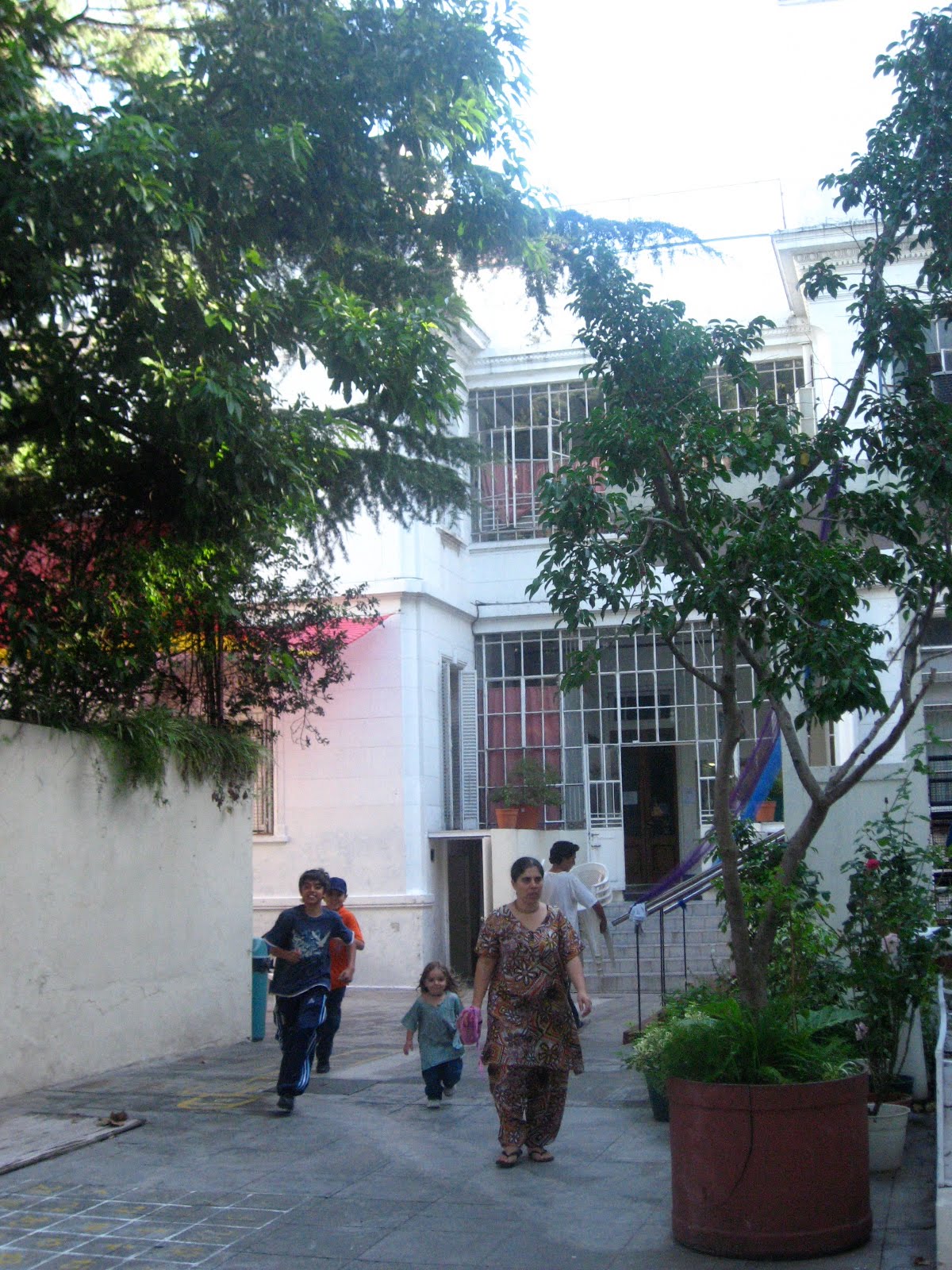
Si no supieras la dirección de antemano, creo que pasarías por el templo de ISKCON en la calle Ciudad de la Paz sin darte cuenta alguna. La entrada es sólo una puertita dentro la pared blanca, fácil de no ver, que no delata nada del mundo que esconde detrás. Pero, por curiosidad o por coincidencia, si acabas pasando por la puerta, ten en cuenta que ya te has transportado al otro lado del mundo.

Yo fui por pura curiosidad, y por una curiosidad específica. En Arizona tenemos también un templo de ISKCON (International Society for Krishna Consciousness, popularmente conocidos como los "Hare Krishna"), pero su base consiste en inmigrantes de la India, es decir hindues de nacimiento, y la pequeña población de convertidos que tenemos es muy marginal. Pero acá, gente de la India no hay para nada (en un mes recorriendo todo Buenos Aires, una capital supuestamente cosmopólita, ni siquiera me he chocado con uno), lo cual significa que son todos convertidos y lo cual me hizo preguntar: ¿por qué estos argentinos quieren hacerse hindues, rechazar su propia cultura para adoptar la nuestra? Y además: si son todos convertidos, ¿cómo sabemos que no lo hacen todo mal y equivocado, que no distorsionan el hinduismo?

Así, sospechoso y curioso, pasé por la pared del templo. Primero, me encontré en una plaza. En frente había un edificio bastante alto, de alrededor de tres pisos, y a la izquierda había otro de un piso, con un subsuelo también.


De las escaleras del subsuelo estaba saliendo un monje, llevando un dhoti y con la cabeza calva salvo un mechón al fondo. Me saludó con "Hare Krishna!" y me llamó "Prabhu," y después de darle el recíproco saludo, le pedí que me mostrara el templo.

Resulta que no había mucho para ver, pero en lo que había me fijé intensamente, siempre juzgando en el fondo de mi mente. La primera sorpresa fue ver saliendo del alto edificio a tres o cuatro mujeres y a algunas jóvenes, todas llevando salvar-kamiz. Adentro había un tipo de guardería, con unos cinco chicos y algunas jóvenes y mujeres cuidándolos. En la televisión se había puesto una película ilustrada de la Ramáyana (acá se prenuncia como Ramayana) y en frente de estantes llenos de muñecas hindues decorativas los chicos y las cuidadores se entretenían con juguetes.

A lo largo de la gira, mientras el monje me iba mostrando lo demás del tempo, todo se volvía en un torbellino de "rica comida vegetariana," cuadros de Radha-Krishna, harmonium al lado del altar, y más y más gente en ropa hindú, todos llamándome "Prabhu" y platicando en español (una lengua que ni siquiera se conoce en la India)—y mientras yo estaba mudo, pretendiendo comprender porque es posible encontrar este simulacro de la India acá en la Argentina.

"Mirá, mirá," dijo una de las jóvenes de la guardaría, sonriendo, vestida de una salvar-kamiz rosada, con un niño con ojos rojos en sus brazos. "Él se puso a llorar por la Ramayana, se asustó de Rama. Ja ja ja ja..."

Una de mis grandes interrogantes fue como mi guía, argentino de sangre criollo y católico, llegó a dedicarse a esta vida totalmente ajena. Verle en el lugar donde estaba significa que no sólo rechazó el mundo católico que lo habría rodeado, sino también que había desarrollado fé y convicción en una religión acá totalmente desconocida, pagána, de miles de dioses de miles de manos, con rituales extraños y costumbres absurdas—sin mencionar el tener que dejar de comer todo tipo de carne! No lo podía creer.

Así, como una especie de antropólogo mezclado con psicólogo, me empeñé en entender a este monje a lo largo de la gira, como si estuviera estudiando la biología de un insecto. Instictívamente, me daba vergüenza esta actitúd, pero no al punto de que me parara en insinuarle preguntas que le hicieran confesar su historia. Pretendiendo disimular mis intenciones, le preguntaba, balbuciendo e incómodo, cómo es que llegó a ser monje, por qué dejó el mundo argentino atrás, pero nunca logré una respuesta satisfactoria. Contestaba en oraciones directas y breves y sobre temas que son típicos de convertidos (por ejemplo, algo como "Acá encontré las respuestas que quería") pero sus respuestas no me satisfacieron.

De hecho, al contrario de lo que esperaba, la conversación volvió a enfocarse en mí. Él me preguntó si yo tenía un guru, si leí la Bhagavad Gita, si yo practicaba sinceramente mi religión. Él se hizo el investigador y yo el sujeto, y yo acabé defendiéndome mientras le tocó a él explorar mi identidad. Me recitó frases de la Bhagavad Gita (a lo cual respondía cansadamente que sí conocía, y sabía lo que querían decir) y me regañó por no ser constante en mi práctica.

Esta inversión de papeles me reveló la arrogancia que tenía en creerme juez de los hindues del mundo. En primer lugar, si yo creyera (como pensé que creía) que la filosofía del hinduismo habla de la Verdad, y que trasciende la nacionalidad y la raza y el tiempo, no me debería sorprender que les atraiga a algunos argentinos, tal como me atrajo a mí. Asimismo, si entendiera la Bhagavad Gita (como pensé que entendía), recordaría que dice que no importa la manera en que rezas sino la devoción y la pureza que uno tiene.

No es nuestra prerrogativa elegir donde nacemos, pero sí tenemos el derecho de dirigir nuestra vida. Aunque todavía no me caen bien todas las prácticas de los Hare Krishna, no me debe importar si nacieron hindues o no. Nosotros todos buscamos respuestas, de una manera u otra.

Tuesday, March 2, 2010

Buenos Aires, In Idiosyncracies

They say every city has a personality, so as I'm getting to know my new home for the next half-year, I thought I'd document its idiosyncracies—the features that make Buenos Aires, Buenos Aires. Here's my first impression:

1. On almost every city block you will find:


A newspaper stand


A kiosko


A pizzería


Someone with a cigarrete in their hand


2. For 30 pesos, you can get a burger, fries, and a drink at Burger King. For 45 pesos you can eat decently (though also a little thriftily) at this fancy restaurant with linen and a waiter.


3. The Abasto shopping mall seems like one of the fanciest spots in town, with rows and rows of designer stores, like YvesSaintLauren.

In apparent contradiction to its upscale atmosphere, the mall also has not one but three McDonalds: one big one on the ground floor, one in the food court on the third floor, and a kosher one on the other side of the food court. The mall also has an indoor kids carnival called "Neverland," but no one seems to wince but me.


4. Every restaurant serves the same food: pizza, pasta, milanesa (breaded meat), tortilla, omlette, tarta, empanada. Even Acapulco, a Mexican restaurant on la calle Lavalle, can't help itself from putting pizza and pasta on the menu.

5. You can find kids swimming in the fountain in front of the Congress building.


6. A number of cities have lots of grafitti, but only in Buenos Aires is the majority of it political.

"Gane que gane pierde la gente - no votes"


"Basta de mano dura contra el pueblo pobre"


"Los Kirchner a la carcel"

7. It's possible to go a supermarket and not find beans.