I went to see this movie not knowing what I was in for, but that's probably the only way I would have seen it anyway: it's a real mind-f@#%.
The premise is simple: anxiety, tension, and rivalry in a NYC ballet company's production of Swan Lake. But the director, Darren Arenofsky, takes this simple story and makes it a deep and haunting and rich.
The plot goes like this: Nina (played by Natalie Portman) is a ballerina driven to perfection, and yearns for the lead role as the Swan Queen in the company's upcoming production of Swan Lake. She auditions for the role, and she gets it (not before the director tries to get some of her), but with the condition that she needs to fix the weakness in her performance. The Swan Queen part comprises two roles, the White Swan and the Black Swan; and though Nina plays the White Swan to perfection, she has trouble connecting with the dark, imperfect, sensual side of herself to play the Black Swan. At the same time, a new ballerina, Lily (played by Mila Kunis), has joined the company, and she has all the dark edgy qualities required of Nina. Nina's mind starts to buckle under the stress: she deliriously imagines that Lily keeps trying to take her place, and she begins to rebel increasingly violently against her controlling and suffocating ex-ballerina mother. The movie follows her journey into the dark side and her spiraling psychosis.
It's difficult for me to explain why the movie was so scary, but I think the main reason is that in this case the threat is internal. You can always run away from an axe-murderer, but you can never run away from your own mind. Plus, the visuals were really gruesome, and unrelenting. This wasn't a movie that had a rising action, climax, and denouement; instead, the tension only increased and increased as the film went on, until it released spectacularly at the end.
I try to come away from these kinds of heavy films with some lessons, and also I think this film, which is so clearly a glimpse into the mind's abyss, particularly invites it. So here's what I learned:
1. Suppressing any aspect of your personality is not healthy.
At the director's urging, Nina connects with her dark side. But since she had neglected it so much, once she begins to make that connection it overcomes her. Her personality swings to the other extreme and she loses control over her mental equipoise. She isn't able to handle the new ideas and emotions and thoughts that are engulfing her.
2. Perfectionism is an ugly trait.
The crowd that watches Nina's astounding performance only sees the final result, but through the film we witness what the cost is of the perfectionism that leads to that performance. It costs Nina her mental stability—paintings come alive and taunt her, blood stains her hands, she imagines stabbings and voices shouting "I'm not good enough." It costs her her relationship with her mother. It costs her her relationships at the ballet company, where she constantly feels alone and threatened. And ultimately, it costs her ballet: something she presumably picked up for enjoyment becomes mental torture and a death sentence.
Less philosophically:
1. Ballet can be quite vertiginous.
Arenofsky's cinematography does a good job of showing just how alive and quick ballet can be. I've seen a production, and it looks rather static-y and calm from a distance, but after watching Black Swan I realize the dancers themselves experience a quiet whirlwind.
Showing posts with label Film. Show all posts
Monday, December 20, 2010
Thursday, December 31, 2009
Avatar
Within this framework, Mr. Cameron weaves story lines that prove cathartic for our blood-stained and embarrassing history. A good chunk of the middle part of the movie functions as a dramatic reenactment of The Trail of Tears; the way the military and the company work as one unit in the film is reminiscent of the United Fruit Company's exploits in Latin America; and the military commander's callous contempt of and insensitivity towards the Na'vi has echoes of the US military's attitude towards the "gooks" in the Korean War. For those of us familiar with US history, the film forces us to confront our past, learn from our mistakes, and serves as a precautionary warning for the path we must not travel again in the future—an especially timely message as we continue the Iraq War and prepare to escalate in Afghanistan.
Alongside its political message, Avatar also voices what I think is a general anxiety of our society's spiritual decline. The Na'vi are a very spiritual society, in the way of the Native Americans or the Orient, and believe in the oneness of all living beings. The film yearns for a simpler life, connected with nature and other living beings, living in harmony instead of opposition. David Denby of The New Yorker calls this sentiment nothing "more than a whiff of nineteen-sixties counterculture, by way of environmentalism and current antiwar sentiment" and ultimately dismisses it as "sentimentality," but I think he fails to realize the reality and legitimacy of this spiritual need.
And of course, the film is absolutely joyful to see, visually: a real treat for the eyes. What makes these effects worthwhile is that they're not effects for effect's sake, but rather a way of absorbing you into this rich and astounding fantasy world that Mr. Cameron creates. This film has clearly delineated good guys and bad guys, and for that to work the film has to tie you up emotionally with the good guys. By introducing us to the Na'vi's world, and by making us fall in love with it, Mr. Cameron succeeds in making the struggles of the Na'vi meaningful and close; in the end everyone in the theater was openly cheering for them.
Some critics complain that the characters are too simplistic or that the story line is too trite, but I think there is a place for war-of-good-and-evil tales and this movie does a fantastic job of representing the genre. The visuals are stunning; the plot is absorbing (for those who aren't too cynical at least); and after you walk out of the theater you have something to think about. Certainly worth seeing.
Thursday, September 24, 2009
Economics in Film
For some reason it's film season for economics.
For example: The Informant!, which came out about a week ago, stars Matt Damon in a true story about how the vice-president of agri-business giant worked undercover with the FBI to reveal that his company was engaged in an unprecedented global price fixing scheme. Now price fixing may not sound like much—and I thought as much myself until I heard this week's podcast of This American Life.
This week on the This American Life radio program, Ira Glass (the host) replayed a clip from c. 2000, which, it turns out, was essentially responsible for getting this story onto the big screen. Apparently a screenwriter was listening to the program, thought the story would make a good movie, and, well, here we are.
So, what did this screenwriter see in story about price fixing?
Ira Glass explained it something like this: We rarely, if ever, get a chance to find incontrovertible proof of a conspiracy. We may be able to tell that something's amiss, we may have hunches, but in the end we can only speculate, grope in the dark, and collect circumstantial evidence. There's never proof, never closure. Except now. This story represents that one rare opportunity we have to truly truly know what's going...which in this case turns out to mean that evil men are hatching to take over the world.
Ira Glass makes it clear that world domination is by no means a stretch from price fixing. He played some of the FBI's clips of these business executives carving up the markets of the world amongst themselves at some Marriott hotel. [Carving up—as in carving ham, or roast: they argue over the best parts, but in the end they make sure that everyone has a decent meal.] They laugh, chat, and work out complex sums; crumpled wrappers litter the room and stale coffee sits; and, really, in all respects the meeting seems perfectly normal. The only catch is that they're in the process of puppeteering the world food market—food that almost every person on this planet depends on—and, in doing so, ruining small businesses and exploiting the rest of us (and especially the poor). Which is why price fixing is so egregiously criminal and all, but you wouldn't know it from their casual demeanor and guiltless expressions.
I think what makes this storyline so gripping is its dark undercurrent. Nothing is more scary than the idea of men manipulating our lives with such ease. Gods we can live with, but self-appointed gods are too much.* These agri-business crooks get caught, sure enough, justice is served (at least nominally), but the story still doesn't leave you with a happy ending, because all the time you can't help but think: How many more of these guys are there?
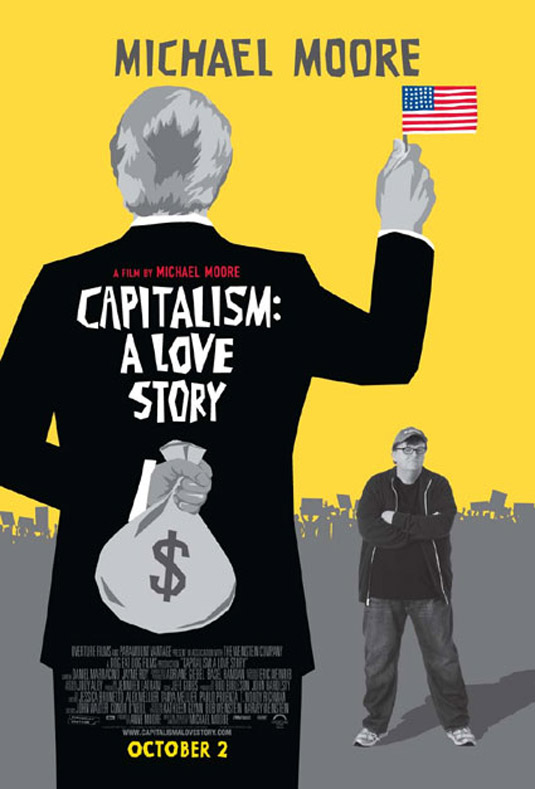
Uncannily enough, that's where Michael Moore seems to pick up in his latest film, Capitalism: A Love Story. I don't know much about the movie, but from the previews it seems he's trying to show how big corporations (like the ones from The Informant!) are engaging in unfair practices to con over the rest of us.
Michael Moore is rather radical, of course, and I realize he trucks primarily in publicity stunts, but looking at his track record I'm still really curious about what he has to say. After all, he got the two big-picture ideas of his last two films mostly right: the Iraq War was, after all, misguided and misplanned; and health care is, after all, a national problem. Let's see if Mr. Moore can go 3 for 0 (speaking big-picture, of course).
*This line comes from one of Tagore's short stories, "Housewife":
This week on the This American Life radio program, Ira Glass (the host) replayed a clip from c. 2000, which, it turns out, was essentially responsible for getting this story onto the big screen. Apparently a screenwriter was listening to the program, thought the story would make a good movie, and, well, here we are.
So, what did this screenwriter see in story about price fixing?
Ira Glass explained it something like this: We rarely, if ever, get a chance to find incontrovertible proof of a conspiracy. We may be able to tell that something's amiss, we may have hunches, but in the end we can only speculate, grope in the dark, and collect circumstantial evidence. There's never proof, never closure. Except now. This story represents that one rare opportunity we have to truly truly know what's going...which in this case turns out to mean that evil men are hatching to take over the world.
Ira Glass makes it clear that world domination is by no means a stretch from price fixing. He played some of the FBI's clips of these business executives carving up the markets of the world amongst themselves at some Marriott hotel. [Carving up—as in carving ham, or roast: they argue over the best parts, but in the end they make sure that everyone has a decent meal.] They laugh, chat, and work out complex sums; crumpled wrappers litter the room and stale coffee sits; and, really, in all respects the meeting seems perfectly normal. The only catch is that they're in the process of puppeteering the world food market—food that almost every person on this planet depends on—and, in doing so, ruining small businesses and exploiting the rest of us (and especially the poor). Which is why price fixing is so egregiously criminal and all, but you wouldn't know it from their casual demeanor and guiltless expressions.
I think what makes this storyline so gripping is its dark undercurrent. Nothing is more scary than the idea of men manipulating our lives with such ease. Gods we can live with, but self-appointed gods are too much.* These agri-business crooks get caught, sure enough, justice is served (at least nominally), but the story still doesn't leave you with a happy ending, because all the time you can't help but think: How many more of these guys are there?
Michael Moore is rather radical, of course, and I realize he trucks primarily in publicity stunts, but looking at his track record I'm still really curious about what he has to say. After all, he got the two big-picture ideas of his last two films mostly right: the Iraq War was, after all, misguided and misplanned; and health care is, after all, a national problem. Let's see if Mr. Moore can go 3 for 0 (speaking big-picture, of course).
*This line comes from one of Tagore's short stories, "Housewife":
But clearly no god can be more malevolent than a man-god. The immortal gods cause nowhere near so much trouble. If we pick a flower and offer it to them, they are pleased; but they don't harass us if we don't offer it. Human gods demand far more; if we fall the slightest bit short, they swoop, red-eyed with fury, not at all godlike to look at.
Subscribe to:
Posts (Atom)